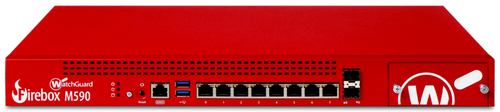
The WatchGuard Firebox M590 with the optional "WatchGuard High Availability for M590 - 3-Year" license is a powerful next-generation firewall and unified threat management (UTM) appliance designed for medium-sized and distributed enterprises that require high performance, continuous availability, and centralized security management. As a member of WatchGuard's Firebox family, the M590 is typically deployed at the network perimeter or at key aggregation points to provide advanced security functions including stateful firewalling, intrusion prevention, application control, VPN connectivity, and more, depending on the licensed services in use. The additional High Availability (HA) option for three years enables redundant deployment of two M590 appliances in an active/passive scenario, significantly improving resilience and reducing downtime risk.
In typical scenarios, the Firebox M590 is used to secure branch offices, headquarters of mid-size companies, or campus environments. It is built for environments where large numbers of users, bandwidth-intensive cloud applications, and remote workers must be protected without sacrificing performance. Administrators can usually centrally manage security policies, set up VPN tunnels for site-to-site or remote access, and enforce consistent protection standards across multiple locations. Key technical characteristics of an appliance in this class commonly include several multi-gigabit Ethernet interfaces, support for high throughput firewall and VPN traffic, and flexible deployment modes such as routed, transparent, or mixed environments. The HA subscription for 3 years is specifically intended to link two identical M590 devices into a redundancy cluster so that if the primary appliance fails, the secondary can take over and maintain network connectivity and security policies with minimal interruption.
From an application perspective, companies use the Firebox M590 to protect web traffic and email, filter unwanted or dangerous content, and monitor network communications to detect and block threats. Unified security functions often include IPS (Intrusion Prevention System), reputation-based defense, advanced malware detection, web blocking and application control, depending on the security services activated. With High Availability, these protections remain active even when hardware problems, maintenance tasks, or firmware updates require failover to a second unit. This is particularly relevant in environments that operate around the clock, such as healthcare, logistics, e-commerce, financial services, or manufacturing, where unplanned downtime can quickly lead to high costs and productivity losses.
The advantages of the Firebox M590 together with the 3-year High Availability option include a high level of reliability, scalability for growing networks, and simplified management through WatchGuard's standard management tools. High Availability enhances business continuity: it helps maintain critical connections to cloud services, data centers, and remote offices, and reduces the risk of security gaps during outages. Over a three-year period, the HA license provides planning security and supports long-term infrastructure strategies.
WatchGuard is an established manufacturer of network security solutions, known for its Firebox appliance family and cloud-based management offerings. The company focuses on providing enterprise-grade security in formats that are manageable even for organizations without large IT departments. Publicly available information from the industry indicates that many security vendors, including WatchGuard, increasingly consider aspects such as energy efficiency of hardware, consolidation of security functions in a single appliance, and cloud-managed architectures that can reduce the need for additional on-premise equipment. While specific, verifiable sustainability programs of WatchGuard are not detailed here, choosing a consolidated, modern security platform such as the Firebox M590 can in many cases help reduce hardware sprawl, power consumption, and cooling requirements compared to maintaining multiple separate devices for firewall, VPN, and content filtering. By purchasing and deploying a solution of this kind, customers can contribute to more efficient IT operations, which is often associated with lower resource usage and a more responsible infrastructure footprint--while at the same time significantly improving the protection of users, data and digital services.